
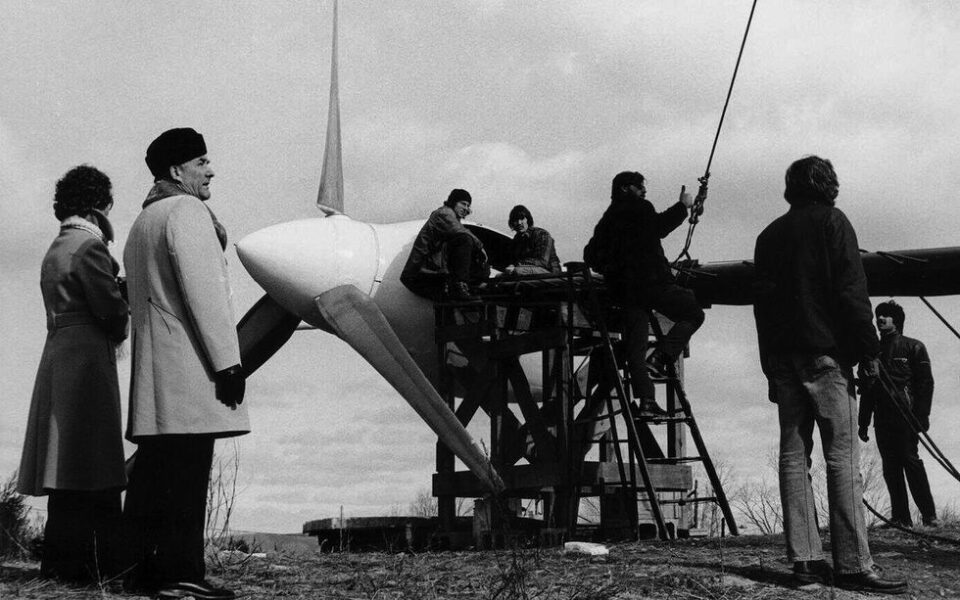
A half century ago, a scrappy crew at the University of Massachusetts Amherst erected a wind turbine on Orchard Hill, the highest point on campus. It was a frugal production, cobbled together from the rear axle of a Ford truck, a donated generator and microcontroller, a steam pipe, and various handcrafted steel and fiberglass parts, including its 4.5-meter blades.
The team of UMass engineering grad students, faculty advisors, and one precocious undergrad built it to prove that wind energy could keep rural homes toasty in New England’s frigid winters, as a way of trimming U.S. oil dependence—a national imperative in the aftermath of the 1973–1974 energy crisis. To illustrate the point, they also assembled a modular home there on Orchard Hill, and outfitted it with heaters that would be powered by the turbine.
In 1975 and 1976, a crew from the University of Massachusetts Amherst designed and constructed the 25-kilowatt wind turbine that kick-started the U.S. wind industry. Sandy Butterfield
It worked—too well. “We had to open up the doors in the dead of winter. It was just too damn hot,” recalls Michael Edds, who designed the turbine’s electrical system and served as the project’s first resident engineer. Fittingly, they dubbed the turbine the “Wind Furnace.”
The turbine maxed out at 25 kilowatts—puny compared to modern machines that generate up to 26 megawatts, but more than most energy experts expected from wind technology in November 1976. Back then, wind power still conjured up images of quaint Dutch mills and creaky prairie water pumpers. Crafty engineers would soon show that wind power could be so much more. And it all began with the brilliant, commanding, and often polarizing UMass professor leading the Wind Furnace project: William Heronemus.
A retired U.S. Navy captain, Heronemus had joined the UMass faculty in 1967. He’d earned Bronze Stars for valor in World War II, designed and built nuclear submarines, and liaised with the British Royal Navy on the Polaris missile. UMass had recruited Heronemus to do ocean engineering, but the energy crisis and his growing misgivings about nuclear power shifted his attention to renewable energy.
Heronemus, photographed circa 1973, publicly advocated for the buildout of wind turbines, both onshore and off, at immense scale. Robert S. Cox Special Collections and University Archives Research Center/UMass Amherst Libraries
By 1972, Heronemus was advancing detailed designs to deploy wind turbines at immense scale. That year, at the Marine Technology Society’s annual gathering in Washington, D.C., he presented schemes for building thousands of them across the Great Plains as well as a vast grid of massive floating turbines transecting New England’s continental shelf. Wind power, he contended, could generate nearly a fifth of U.S. electricity needs by the year 2000. Never mind that the technology for such an enormous buildout had yet to be commercialized. Espousing grand schemes made Heronemus a quixotic figure.
He also vigorously attacked the commercialization of nuclear power, creating enemies within electric utilities and U.S. government agencies that saw nuclear technology as the future. They didn’t appreciate his claims that a cleaner energy future via wind was ready to be tapped, and that the push for nuclear power and its radiological risks was unnecessary. As author and energy analyst Peter Asmus put it in his 2000 book, Reaping the Wind: “William Heronemus was a dangerous man suggesting an audacious departure from the status quo.”
The UMass Amherst wind turbine generated most of the energy to heat a modular home through the cold, windy winters on Orchard Hill. Solar thermal panels provided some heat during windless periods. Robert S. Cox Special Collections and University Archives Research Center/UMass Amherst Libraries
What happened on Orchard Hill in 1976 marked Heronemus’s turn from provocateur to changemaker. The success of the experimental turbine set off waves of technological and industrial developments that forever changed the energy landscape. Within a few years, the students he trained and the entrepreneurs he inspired were building the world’s first modern wind farms and leading the Great California Wind Rush—the market that turned wind craft into an industry that’s still growing fast half a century later.
Globally, annual wind generation more than tripled between 2015 and 2025, according to data from Ember Energy, a think tank based in London. It will best nuclear’s global output by the end of this year, Ember predicts. And it all started with Heronemus, says Robert Thresher, longtime former director of wind research at the National Renewable Energy Laboratory (NREL) in Golden, Colo. (a U.S. Department of Energy lab rebranded late last year as the National Laboratory of the Rockies). “In my mind he was the father of the people that went out and really made the industry what it is today,” he says.
William Heronemus and the History of Wind Power
I got to know Captain Heronemus posthumously, interviewing his contemporaries and sifting through boxes delivered to the UMass Amherst archival research center’s 25th-floor reading room. During three visits there since 2023, I have discovered clues to his life, thinking, and research process amid the writings where he pitched his big ideas to the world. His papers include proposals to governments, utilities, and deep-pocketed philanthropists and investors, including Jane Fonda and Goldman-Sachs. Papers reveal the internationalism and commitment to service that took Heronemus on renewable-energy consulting trips to Pakistan, Cuba, Côte d’Ivoire, and beyond. Records show meetings with corporate powerhouses like Boeing and Grumman Aerospace and calls on politicians, including the senator and presidential hopeful Ted Kennedy. Postcards from former students exude gratitude.
Heronemus sits with a mock-up of a multirotor turbine in his cramped office in Marston Hall, UMass Amherst’s main engineering building. Robert S. Cox Special Collections and University Archives Research Center/UMass Amherst Libraries
I learned that Heronemus turned his attention from ocean engineering to energy a few years after arriving at UMass, when he saw the growing string of nuclear power plants going up along the Connecticut River, which flows past Amherst en route to Long Island Sound. The U.S. government had picked nuclear power as an antidote to the 1970s oil crises, and Northeast utilities had jumped in big. But Heronemus and other UMass engineers worried that the riverside reactors’ waste heat would threaten the river’s ecosystem and bounty.
The advent of cooling towers to blow off heat into the air addressed the thermal pollution concern but created another: water depletion. (Nuclear plants consume about 60 million gallons of water per day, per reactor, on average.) And Heronemus perceived other nuclear power liabilities, stemming from his experience with nuclear propulsion on Navy ships. As a design engineer and head of construction and repair for a shipyard, he valued the military’s zero-accident standard for reactors but also knew the high cost of adhering to it. He argued that building expanded versions of the Navy’s pressurized water reactors to power cities and factories couldn’t be both safe and economical.
In 1971, Heronemus designed an offshore turbine with three rotors, but the first big multirotor prototype wouldn’t be built for another four decades. Robert S. Cox Special Collections and University Archives Research Center/UMass Amherst Libraries
He predicted—accurately, as it turned out—that costs would rise sharply as the nuclear industry addressed safety and environmental concerns. “Each plant costs more than its predecessor. The shipyards involved with nuclear reactors came to that conclusion years ago,” he wrote in a 1973 research proposal. He also argued that the risks inherent in nuclear reactors and their radioactive waste were unnecessary given Earth’s abundant solar and wind energy resources. He broadcast those views wherever and whenever he could: before congressional committees, at U.S. Atomic Energy Commission hearings, at academic conferences, in media interviews, and even at Rotary Club luncheons.
At a 1973 licensing hearing for the proposed 820-MW Shoreham Nuclear Power Plant on Long Island, N.Y., for example, Heronemus called affordable nuclear energy a “myth.” He detailed, in its stead, a floating wind power system that could be moored off Long Island and sized to deliver more than four times as much electricity as the Shoreham plant. Each of the 640 floating platforms would carry six rotors and crank out up to 12 MW, some of which would power electrolyzers to generate hydrogen. The hydrogen would be fed to power plants or fuel cells to produce electricity when the wind wasn’t blowing. This seemingly futuristic idea drew on his Navy experience with water-splitting electrolyzers, which supplied the oxygen that enabled subs to remain submerged for months at a time, and NASA’s use of hydrogen fuel cells to power the Apollo missions.
More than five decades later, his vision for offshore wind power is big business. Floating platforms are now widely accepted as the future of offshore wind, as necessity pushes the industry to build in deeper waters. Testing began on the first floating electrolysis platforms in 2023, and multirotor turbine prototypes are in development in China, Norway and Scotland.
The UMass Amherst Wind Turbine Legacy
Photos in the UMass archives invariably capture Heronemus in jacket and tie, usually standing bolt straight. That commanding affect, plus his World War II veteran pedigree, Cold War engineering credentials, and his informed, pugnacious attacks made him a hard target for his adversaries in the nuclear establishment. He certainly wasn’t your typical antinuclear activist.
Wielding his Cold War engineering credentials and often dressed in a suit and tie, Heronemus fought hard against nuclear energy, arguing that wind was a far safer and cost-competitive resource.Robert S. Cox Special Collections and University Archives Research Center/UMass Amherst Libraries
But brutal candor in public settings probably won him as many enemies as friends. Consider his presentation at the IEEE Power and Energy Society’s 1974 winter meeting, where Heronemus suggested scrapping the utilities’ then nuclear-focused research arm, the Electric Power Research Institute. That stance no doubt created discomfort for the engineers in attendance who were involved in EPRI projects, or who aspired to be.
It’s hard to say whether Heronemus’s campaign slowed nuclear development. The industry was already struggling with cost overruns when, in 1979, a reactor at Three Mile Island in Pennsylvania partially melted down and slammed the brakes on further expansion.
What is certain is that Heronemus spurred investment in wind power. When he started talking up wind in the early ’70s, even fellow travelers in the fledgling renewable energy movement were writing it off. As future White House science advisor John Holdren opined in a 1971 Sierra Club book: “There are few places in the world where the wind is strong enough and steady enough to make harnessing it for the large-scale production of power at all interesting.”
Heronemus dreamed up networks of wind turbines over and along highways after driving down the Garden State Parkway to a conference in Cape May, New Jersey. Ellen Heronemus
Heronemus countered the naysayers by quickly forging expert consensus around wind power’s immense potential, playing a key role as the sole wind expert on a 1972 federal panel on renewable energy. That joint National Science Foundation–NASA panel concluded that, in fact, wind could meet up to 19 percent of projected U.S. power demand by the year 2000.
Congress listened, sort of. After most Persian Gulf states restricted oil shipments to the United States in 1973, congressional appropriators dedicated US $1.8 million to wind-power research and development for 1974—up from zero—and by 1976 it had bumped that to $22 million. (For comparison, Congress gave nuclear power $714 million in 1976.)
Heronemus’s vision for a massive highway wind-power scheme was inspired in part by the wind-power advocate Percy Thomas, who in the 1940s and 1950s “talked a lot about how fresh New Jersey winds are,” he told the New York Times in 1974. “I got to thinking about what Thomas had said and how wind energy could be captured there.” Ellen Heronemus
The bulk of the funding for wind power flowed to big aerospace firms and to NASA, financing an ultimately fruitless attempt to leap straight to megawatt-scale wind turbines. UMass struggled to grab a slice of the leftovers to pursue Heronemus’s offshore wind system. Professors and students who worked with Heronemus told me they felt they’d been blackballed as payback for his activism and antagonism.
UMass finally caught a funding break when Heronemus dialed back his ambitions and proposed the 25-kW unit for Orchard Hill. A $130,000 federal grant landed in early 1975, and $150,000 more the following year. It was a “trivial” sum, according to team member Sandy Butterfield, who would later become chief engineer for wind-turbine testing at NREL. “They gave us just enough to fail,” says Butterfield.
A crane erects the “Wind Furnace” in November 1976. Sandy Butterfield
But the project triumphed, resulting in Wind Furnace 1, or WF-1 (pronounced “woof one”). The young engineers behind it credit their success to the confidence, sense of mission, and structure that Heronemus gave them. The self-described “hippies” called Heronemus “the Captain” out of both affection and respect.
As team member Edds puts it: “What showed in his demeanor and his actions was discipline, and it sort of rubbed off on us. We didn’t always dress like the Captain, but we knew we had to be disciplined, to be prepared, and just do the job.”
From Helicopter Rotor to Wind Turbine
Team WF-1 got a quick start, thanks to earlier, privately financed work by a couple of doctoral students, including Forrest “Woody” Stoddard. Stoddard had been designing helicopter rotors for the U.S. Air Force when Heronemus invited him to come work on wind power in 1972. Stoddard set about adapting helicopter-rotor theory to the closely related wind rotors, and his aerodynamics modeling proved essential to the engineering of the entire machine.
Woody Stoddard [far right, in hat] designed the fiberglass blades with Ted Van Dusen. The team assembled the blades in a campus shop, and when it was time to squeegee epoxy from the blades, it was all hands on deck. Robert S. Cox Special Collections and University Archives Research Center/UMass Amherst Libraries
As WF-1’s de facto chief designer, Stoddard likely supported the team’s early choice to mimic a helicopter’s ability to “pitch” its blades. To fly forward, a helicopter continuously adjusts the lift created by each blade, turning the airfoil on its long axis to reduce lift as it swings past the front of the aircraft. Doing so tilts the nose down and moves the vehicle forward. In WF-1’s case, blades pitched to regulate torque, helping get the rotor spinning in low winds and then easing off to protect the machine in dangerously high winds.
Repurposing a truck axle to mechanically couple WF-1’s rotor and generator was one of several design elements borrowed from engineers at McGill University in Montreal. Production of WF-1’s fiberglass blades got started at UMass in 1974 under the direction of doctoral student Ted Van Dusen. A competitive rower, he had a side hustle making ultralight composite boats—a trade that had stalled his doctoral work at MIT but was an accelerant for WF-1.
The federal funds in 1975 allowed Heronemus to really spin up the project and recruit a squad of students to engineer the balance of WF-1’s components. They made good use of the UMass engineering machine shop and received guidance from faculty, including mechanical engineering professors Duane Cromack and Jon McGowan. But it was the dozen or so students who really cranked out the parts.
Most were master’s students, like Butterfield, who designed the blade-pitching mechanics. Edds, the team’s only electrical engineer, had come to UMass to learn ocean engineering, only to be diverted into handling WF-1’s generator. Louis Manfredi, another ocean engineering student, teamed up with master’s student Jim Sexton on the nacelle housing the generator and drivetrain. Fred Antoon adapted the truck axle. Brian Kuhn did drawings.
WF-1 contained a mechanism that pitched its blades to regulate torque in response to wind speed, a feature that became an industry standard.Sandy Butterfield
An 18-year-old freshman, Dan Handman, came aboard and soon made himself indispensable. When he approached Heronemus to introduce himself, Heronemus handed him three months’ worth of anemometer readings punched into recording paper, and told him to turn it into 15-minute averages. Figuring there had to be a more efficient method for analyzing wind speeds, Handman asked around and found a wind-averaging machine from an earlier student project. A month or so later, he’d installed it in a cabinet near Heronemus’s office and wired it to an anemometer on Orchard Hill.
Handman’s primary role on WF-1 was setting up its computerized control system, which tracked wind speed and sent commands to Butterfield’s pitch mechanism. The controls also tracked the generator’s speed and adjusted the current to its rotor windings, in accordance with calculations by Edds. Tweaking the current ensured that power demand from the electric heaters installed in the home below didn’t stop the rotor in weak winds.
Sandy Butterfield, part of the 1970s “UMass Mafia” team that built WF-1, became a wind-power entrepreneur and a top engineer at the National Renewable Energy Laboratory in Golden, Colo. Sandy Butterfield
The finished WF-1 really cranked up the heat, some of which was stored by heating water in tanks in the modular house’s basement, to be circulated through baseboards in windless periods. It turned out WF-1 was unusually efficient at capturing wind energy because its rotor could change speed with the wind, keeping the blades close to an aerodynamic optimum.
This varying rotor speed meant that the frequency of the electric power WF-1 produced also varied. Turbines linked to power lines must strive for the opposite—a steady output that synchronizes with the grid’s frequency—primarily 50 or 60 hertz. But it suited the home’s low-tech heating scheme just fine. (Electronic converters let today’s turbines have it all by ingesting a variable wave and outputting a new wave that’s synced to the grid.)
The Great California Wind Rush
In 1977, with WF-1’s success in hand, Heronemus projected that 3 million homes like the one on Orchard Hill could soon slash U.S. heating oil demand by 90 million barrels a year. That never happened, but an industry was born, starting with a Burlington, Mass. startup called US Windpower—the first “credible” U.S. turbine manufacturer, according to Thresher, who is now an emeritus researcher at the National Laboratory of the Rockies.
Belgian-made WindMaster turbines erected at Altamont Pass signaled the internationalism of the California wind rush. UMass team member Woody Stoddard conducted engineering analyses of many early designs deployed there.Bettman/Getty Images
Boston-area entrepreneurs Russell Wolfe and Stanley Charren launched US Windpower with Stoddard and Van Dusen after visiting Heronemus in 1974 and liking what they heard. They adapted WF-1’s design to make it suitable for grid-connected operation, building and breaking prototypes before erecting the world’s first grid-connected wind farm in 1980—20 turbines on a mountain in New Hampshire. California’s water authority placed an order for 100 MW of wind power, and in 1981 US Windpower began installing hundreds of turbines in Altamont Pass, east of San Francisco.
As more firms jumped to California, drawn by state government incentives, WF-1’s creators and the next cohort of UMass grads assumed important roles in the nascent market. Seven joined Energy Sciences, a startup cofounded by Butterfield. More joined U.S. Windpower. Stoddard left that company to start a consulting firm and ended up advising some of Denmark’s modern wind pioneers, which rapidly expanded thanks to the California market. Those early Danish firms made relatively simple, sturdy machines that subsequently scaled up and dominated globally for several decades — until China embraced wind power.
The California wind power boom peaked in 1986, after which energy prices collapsed and incentives faded. Most manufacturers were bankrupted by equipment failures and financial challenges, making the 1990s a tough time for wind power’s pioneers. Many UMass wind engineers, like Butterfield, joined Thresher’s operation at NREL, culling everything they could from the California experience.
“An entire generation of U.S. wind engineers got their graduate training, at least in part, using the Wind Furnace.”—Harold Wallace
There, Heronemus’s protégés became known as the “UMass Mafia.” Thresher says it attests to the crew’s impact: “There were others. But that UMass Mafia were really leaders in the field. I think that’s the heritage we got from Bill Heronemus. Those people were so impactful and the education they got [with Heronemus] was the key.” What Heronemus began at the university became the UMass Wind Energy Center, which has awarded over 300 graduate degrees.
WF-1 now rests in the Smithsonian Institution’s collections in Washington, D.C. It earned its place there, as Smithsonian’s only modern wind turbine, because it represents wind energy’s revival, according to Harold Wallace, Smithsonian’s curator for electricity collections. “An entire generation of U.S. wind engineers got their graduate training, at least in part, using the Wind Furnace,” he says.
Heronemus didn’t get to witness the production of the massive offshore machines that he foresaw. He lost his long fight with cancer in November 2002, at the age of 82, even as former students and family members were racing to patent his multirotor and floating turbine designs.
Had he lived longer, the Captain would almost certainly have railed against current U.S. energy policy. The U.S. government has never backed wind power as generously as he’d hoped. Wind supplied 10 percent of U.S. generation last year—that’s half the share in Europe—with offshore turbines providing only a tiny sliver. Federal support for wind power has been in a stop-go cycle since Ronald Reagan’s administration, and it’s hit a low again under President Donald Trump, who has vowed to stop wind power cold. As Trump boasted to oil executives in January: “We have not approved one windmill since I’ve been in office, and we’re going to keep it that way.”
Under Trump, stop-work orders have disrupted offshore projects from Massachusetts to Virginia, contributing to a nearly $600 million loss in 2025 for GE Vernova’s wind business. GE Vernova is the only major wind turbine manufacturer remaining in the United States, and it too can be traced back to Heronemus via a US Windpower patent.
In stark contrast, European and Asian countries have been going big on offshore wind and are now developing floating wind farms to push into deeper waters. China might be the one to finally conjure up Heronemus’s favored wind design: floating platforms bearing massive multirotor machines. In 2024, Zhongshan-based turbine maker Ming Yang Smart Energy Group deployed a two-rotor offshore prototype. The company says its next iteration will generate a whopping 50 MW—a twin-headed beast that would be the world’s most powerful wind machine.
That will be a bittersweet moment for the U.S. wind industry and Captain William Heronemus’s UMass Mafia, for whom such massive machines are a dream come true. Joanne Carroll, a retired member of the UMass Mafia, says she remembers the very moment, her freshman year, when Heronemus’s dream became hers. While he was lecturing in Introduction to Engineering about the hidden costs of coal-fired power, Heronemus walked to the window and said: “‘But out there there’s wind, and you can harvest that energy,’” Carroll recalled. “And I remember thinking: That’s what I want to do with my life.”
The author would like to give special thanks to UMass professor emeritus James Manwell for his assistance with this story.
