
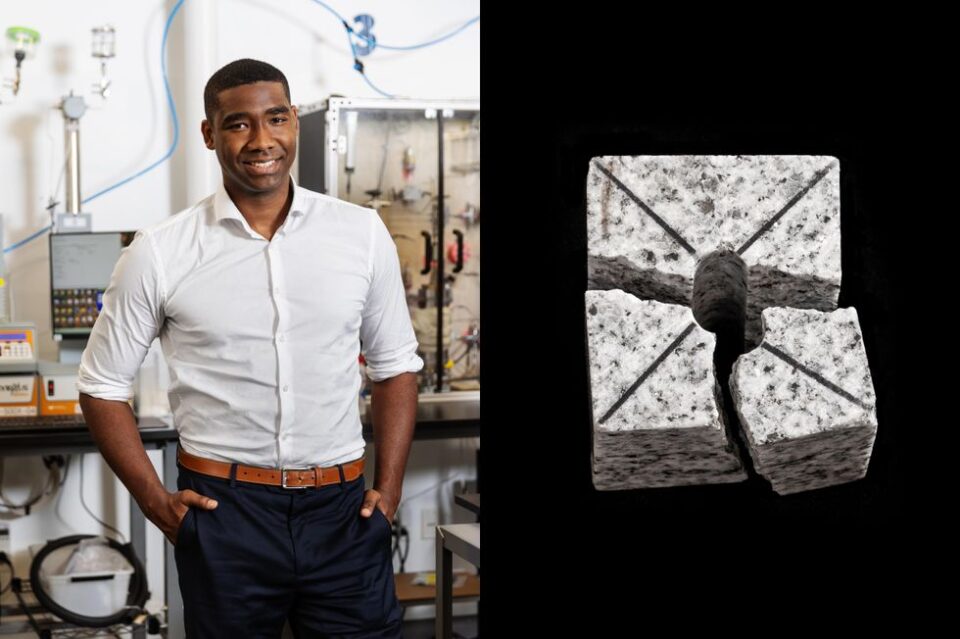
In a tranquil Boston suburb, on the far edge of a horse farm, where pasture gives way to woods, a crane lowers an enormous electrode into a borehole. The electrode, a half-meter-long cylinder with copper-tipped arms to ensure good contact with the borehole walls, descends—deeper, deeper—through layers of spongy sandstone to the hard, marbled roots of an ancient mountain range hundreds of meters below ground. Here the rock is tight; there are few cracks for water or gases to flow. But that’s about to change.
A stone’s throw away, a second electrode—a twin of the first—has been fixed in another borehole at the same depth. From above ground, a pair of high-voltage generators cabled to the two electrodes fires a series of pulses.
Tsss!…Tsss!…Tsss!…Tsss!…Tsss!….
Each discharge, heard faintly at the surface, is like a miniature, subterranean lightning strike. The rock between the electrodes heats. Pressure builds. Then, suddenly, the rock splits into a spiderweb of fractures.
On a horse farm outside of Boston, a worker sets up the well where Eden’s electrode will be lowered with a winch.Bob O’Connor
Eden GeoPower, the Massachusetts-based startup performing this peculiar field test, calls the technology electrical reservoir stimulation. The company’s tagline: “We break rocks with electricity.”
Eden’s researchers hope their rock-breaking technique will someday aid mineral mining, tap geothermal heat, or create geologic storage areas for carbon. But there’s an even more intriguing use that could create a whole new category of energy production: generating hydrogen underground.
The dream of a hydrogen-powered economy dates back to the 1970s, when petroleum shortages and rising concerns about pollution from fossil fuels sparked visions of cars, ships, planes, and industrial machines running on hydrogen instead of carbon. Hydrogen is often touted as a clean fuel because when it’s burned or consumed in fuel cells, it emits only water and heat. However, it currently takes more energy to make than it yields, and the cheapest and most common way is by reacting steam with methane, a potent greenhouse gas.
How to Break Rocks With Electricity
It’s possible to make zero-carbon hydrogen by splitting water with electrolyzers powered by renewable energy. But in most cases, the process is too expensive to be economical—a reality that burst the hydrogen-hype bubble in the early 2020s. Global demand for hydrogen in 2024 reached approximately 100 million tonnes, containing energy equal to only about 3 percent of the world’s annual energy consumption. Most of it is used as chemical feedstock for petroleum refining and for making fertilizers and plastics.
The frustrations of manufacturing clean hydrogen have convinced many entrepreneurs and scientists to instead seek the element underground. For the past half-decade, dozens of companies around the world have been hunting for buried stores of hydrogen, called natural or geologic hydrogen. But with a commercial-scale operation yet to be proved, Eden and a handful of other startups and research groups are chasing the more audacious scheme of producing geologic hydrogen artificially.
This approach, known as stimulated geologic hydrogen or engineered hydrogen, turns subterranean rock formations into giant hydrogen factories. It typically involves injecting water into iron-rich rock, which oxidizes the iron and releases hydrogen as a by-product. Fracturing the rock, as Eden is doing, creates a network of conduits for the water to reach iron-bearing minerals.
The concept of stimulated hydrogen is so new that few have had a chance to test it. Proponents say that if it works—which is a big “if”—it could provide almost unlimited energy for the indefinite future. There’s one way to find out: Start breaking rocks.
There’s Plenty of Underground Hydrogen
Hydrogen is the simplest and most abundant element in the universe, the stuff of stars and galaxies. Geologists have long known that Earth generates hydrogen gas through natural water-rock reactions, but until recently, the occurrence was regarded as a curiosity. The gas is so light that most experts assumed it all escaped through pores and cracks in Earth’s subsurface and didn’t accumulate in useful quantities.
During a demonstration at Eden’s testing site near Boston, an employee displays a central component of the company’s proprietary electrode. Bob O’Connor
Inklings that they were wrong emerged in the 19th and 20th centuries, when researchers in the former Russian Empire and Soviet Union reported hydrogen seeping from mines and wells. But in the ongoing frenzy for fossil fuels, these observations were largely overlooked or forgotten. Scientists later discovered hydrogen spewing from hydrothermal vents in the seafloor and feeding so-called eternal flames, like those of Türkiye’s Mount Chimaera, where ancient athletes lit torches for the first Olympic games.
Then, in 1987, in the village of Bourakébougou, Mali, people drilling a water well noticed a breeze blowing out of the hole. According to local lore, a worker leaned in for a closer look, a lit cigarette dangling from his mouth. The air instantly ignited, burning a brilliant blue.
The crew capped the well, which stayed sealed for 25 years until, in 2012, a Malian oil and gas prospector confirmed the ground contained a large reservoir of hydrogen. The prospecting company, now called Hydroma, had a small electrical plant constructed to convert the gas into power for the village’s residents. Soon after, startups in Australia, Canada, the United States, and elsewhere began searching for more hydrogen stores. By 2025, large multinational petroleum and mining companies were getting in on the game.
To date, hundreds of exploratory wells have been drilled across the globe. But although researchers have documented widespread hydrogen deposits, none have proved capable of producing the gas at rates and quantities needed for commercialization. “We’ve poked a lot of holes, and nobody has found the gusher—or at least they’re not talking about it,” says Douglas Wicks, a former program director at the United States’ Advanced Research Projects Agency—Energy who now advises companies pursuing geologic hydrogen.
A wellhead guides multiple lines downhole: fluid hose, electric cables, rope, control for a sealing device, and sensor communication. Bob O’Connor
Wicks says that in 2022, while at ARPA-E, he got “dragged into the rabbit hole of geologic hydrogen” by Emily Yedinak, then a Fellow at the agency, who was trying to convince her colleagues to take it seriously. “I was the ultimate doubter,” Wicks says. The astronomical price of electrolyzers had made him skeptical that clean hydrogen was a viable pursuit. Plus, if Earth really did contain vast pools of hydrogen, then surely humanity, which had been digging for natural resources for thousands of years, would have found them by now, he reasoned.
But after talking with geologists—who pointed out that people historically hadn’t found hydrogen because they hadn’t been looking for it—Wicks changed his tune. “I got the epiphany that geologic hydrogen is not just an accumulation; it’s a chemical reaction,” he says. “And if it’s a chemical reaction, then it can be stimulated.”
Finding large accumulations of geologic hydrogen entails stumbling on a Goldilocks set of conditions. You need iron-rich source rocks that have already produced or are producing bountiful hydrogen. You also need porous reservoir rocks that can hold sizable quantities of gas migrating from the source rocks. And you need solid cap rocks above the reservoir that trap the gas underground.
To stimulate hydrogen, however, you don’t need this just-right geology. All you need are iron-rich rocks, and then you can generate the hydrogen yourself.
“These rocks are everywhere,” Wicks says. “If you look at the amount of iron that’s within drilling range of Earth’s crust, you’re talking about quadrillions of tons of hydrogen being accessible. If we’re 1 percent successful just in the United States, we could power the economy for thousands of years.” A back-of-the-envelope calculation convinced him that the cost of stimulated geologic hydrogen could easily compete with hydrogen made from methane. “If we get the technology right,” he concludes, “this could be huge.”
Wicks wasn’t the first person to propose the idea, but he was the first to allocate major funding. In 2024, under his leadership, ARPA-E awarded US $20 million to 16 teams aiming to advance stimulation technologies and research. Winning ideas included fracturing rocks with fluid pressure or mechanical stimuli, exposing them to catalysts to speed hydrogen-generating reactions, and manipulating native microbial communities to enhance production. Eden’s rock-breaking project, the lone electricity-based approach, received $900,000.
Eden GeoPower’s Underground Rock Fracturing
Paris Smalls, Eden’s CEO, founded the company in 2017 as a 23-year-old graduate student at MIT. For his Ph.D. in civil and environmental engineering, he was studying the effects of electricity on rock strength and became interested in enhanced geothermal systems, which require fracturing hot, dry rocks to circulate water through them for extracting heat. This is typically done by hydraulic fracturing, or fracking—a technique borrowed from the oil-and-gas industry that involves injecting high-pressure fluids.
Fracking is controversial because it can cause earthquakes and groundwater contamination, and many regions have banned the practice. From an engineering perspective, it’s also imprecise. The fractures it forms are large and difficult to control. “You can’t get enough fractures where you want because the water ends up just going through the same cracks,” Smalls explains. Electricity, he knew from his Ph.D. work, could create more extensive and finely tuned fracture networks, enabling geothermal systems to produce more heat with less environmental risk.
To determine how permeable its fracture networks are, Eden measures fluid pressure downhole and flow rates at the surface. Bob O’Connor
Smalls immediately grasped that the same rock-breaking strategy could be used for mineral mining, carbon sequestration, and extending the life of oil and gas wells. But he hadn’t considered using it to make hydrogen. So when Wicks invited him to apply for the hydrogen program at ARPA-E, he was confused. “I didn’t get it at all,” Smalls says. “I’m like, ‘I break rocks. How am I going to generate hydrogen?’”
Not long after, Smalls met Alexis Templeton, a geomicrobiologist at the University of Colorado Boulder who had become an expert in geologic hydrogen by studying microbes that consume the gas and the mineralogical transformations that create it. “There was a lot of early interest in whether or not you could engineer the production of hydrogen from rocks,” Templeton recalls. “And the rocks with some of the best potential have all the right chemistry, but they need water. Nobody was excited to do hydraulic fracturing. So everyone was wondering, ‘Well, how are we going to get the water in?’”
Eden’s technology, Templeton understood, could be the answer. She agreed to join the company part-time as its lead geochemist, a position she held from 2023 to 2025. During that time, Eden ran its first pilot experiment, in an oil field in Oman, near where Templeton was already doing her own hydrogen research. The initial setup used DC power to send a steady flow of tens of kilowatts between electrodes in two wells. When Smalls’s team tested it in a petroleum reservoir made of soft, chalky carbonate, the rock fractured readily, increasing oil production by 30 percent.
But when they did the same test in hard rocks, like those needed for hydrogen and geothermal systems, they didn’t fracture much at all. So the team went back to the drawing board and came up with a fix: pulsed power.
Using Pulsed Power for Rock Fracturing
The idea of breaking things using pulsed power—short, concentrated bursts of electrical energy—originated with a mid-20th-century experiment in Soviet-era Russia. As the story goes, a physicist and inventor named Lev Yutkin was out in a thunderstorm when he saw lightning strike a log underwater. Rather than burn, as it would in air, the log exploded, as if blown up by dynamite. Intrigued, Yutkin tried to reproduce the spectacle in his lab. He placed a dinner plate in a water tank, dipped in two wire electrodes, and released a high-voltage pulse. The ensuing spark, he discovered, instantly ionized the water molecules between the electrodes into a plasma channel, which then rapidly expanded, creating a shock wave that shattered the plate.
Yutkin described the phenomenon in his 1955 book Electrohydraulic Effect. He later proposed numerous fanciful uses for it, such as cleaning pipes or breaking up kidney stones, which inspired real tools in use today, including electrohydraulic drills and rock-crushers, and a kidney-stone-busting medical device called a lithotripter. The following decades saw advances in pulsed-power systems and experimental techniques to better understand the complex physical processes involved. By the 2020s, when Smalls’s team began investigating it for subterranean rock fracturing, the technology seemed ripe for use, although that particular application had been little explored outside the laboratory.
“We essentially generate a plasma channel in the rock itself,” says Rafael Villamor-Lora, vice president of R&D at Eden. “This channel then expands very, very rapidly,” fracturing the rock with a shock wave. Bob O’Connor
Eden’s scientists first experimented with pulsed power on thumb-size hard-rock cylinders. Instead of submerging each sample in water, however, they placed a pair of electrodes at opposite ends of the cylinder and delivered pulses directly to the rock. Using this dry-pulse method, drawn from Smalls’s and others’ research, the team found they could form plasma in tiny, moist pockets between mineral grains. “We essentially generate a plasma channel in the rock itself,” explains Rafael Villamor-Lora, Eden’s vice president of research and development. With enough pulses, the fast-swelling channel, as in Yutkin’s investigation, induces a shock wave that fractures the rock.
To bring the technology to the field, Eden needed voltage high enough to break through meters of solid rock. The obvious solution was a Marx generator, which converts low-voltage DC power into high-voltage bursts by slowly charging and then rapidly discharging multiple capacitors in parallel. (Marx generators are commonly used in high-energy physics experiments and to simulate lightning strikes on power lines.) Eden custom-built two devices—named Zeus and Thor after the gods of thunder—which together can release a surge of several hundred kilovolts.
This time, the plan worked. In 2025, in an abandoned gold-and-silver mine in Colorado, Eden used Thor to successfully fracture a hard, igneous column, increasing its permeability tenfold.
Ezra Frank, a mechanical engineer at Eden, works on Zeus, Eden’s custom Marx generator. Bob O’Connor
In March this year, the company began setting up the test site on the Massachusetts horse farm to refine its systems and gather more data on how the technology performs in different geologic environments. Its engineers are also designing more powerful generators to discharge stronger and faster pulses. Because Zeus and Thor consume very little power—akin to running a toaster or two—it takes about a minute to store enough energy to fire a maximal pulse. It then takes around 100 pulses to penetrate around 10 meters of hard rock. So fracturing over longer distances or at multiple depths can take hours to days. That means Eden’s biggest cost is labor, not energy.
Smalls says Eden signed an agreement with a geologic hydrogen startup—he declined to say which one—to demonstrate electrical fracturing in a field pilot of stimulated hydrogen, which could begin late next year. Eden will need to prove its technology can help coax the gas from the ground at a profitable rate and cost.
“It’s no question whether we can produce hydrogen,” Villamor-Lora says. “The question is whether we can produce it fast enough to be economical.” In the lab, Eden researchers found they could generate up to four times more hydrogen from rock samples using the pulsed-power technique, compared with the amount found in unfractured samples. But that may not be enough to make stimulated hydrogen commercially viable without some additional technology.
Other Approaches to Stimulated Geologic Hydrogen
One of the biggest challenges in stimulating hydrogen is that there’s no obvious go-to recipe. Beyond the basic ingredients of water and iron, many factors affect how much hydrogen is generated and for how long, and fractures are only one factor. Laboratory studies have shown, for example, that the ideal temperature for maximizing hydrogen production is around 200 to 300 °C. Acidity, rock and water chemistry, and microbial inhabitants are other important considerations.
Making the puzzle more complex, each rock formation is different and may require different stimulation techniques or a combination of them. “There isn’t a single solution that will work everywhere,” says Alexei Tcherniak, CEO of the hydrogen startup GeoKiln. “You have to know the geology you’re operating in.”
Some promising rock formations, he points out, may already be fractured or porous enough to become saturated with water but too cool to make ample hydrogen naturally. To solve this problem, his company, based in Houston, uses a system of underground heaters originally developed for improving flow in heavy oil reservoirs and converting solid organic matter in young shale rock into extractable oil and gas. The heaters, which are commercially available, can be installed in boreholes drilled into hydrogen source rocks, similar to Eden’s electrodes. Tcherniak says that GeoKiln is ready to start field testing as soon as it can raise the capital.
Other researchers are exploring the use of catalysts—metal or chemical salts that speed hydrogen-generating reactions—which, they say, could replace or complement fracturing or heating to increase hydrogen production at less cost. Vema Hydrogen, for instance, is betting on a mixture of boiler-heated water and proprietary catalysts. “What I can say about our catalysts is basically what they are not, which is not toxic, not expensive, and not dangerous,” says Florian Osselin, Vema’s chief science officer. The company, also headquartered in Houston, has begun drilling pilot wells in Canada to test its mysterious brew. By injecting it into semi-permeable rock, Vema expects to achieve commercial production rates without fracturing. “We’ve done field-scale numerical simulations that give us a lot of confidence,” Osselin says.
Another stimulation method, proposed by the Denver-based startup Koloma, aims to expose more rock surface for generating hydrogen by mimicking natural weathering. The technique involves adding carbon dioxide to water and injecting the fluid at specific times to control for factors like acidity and gas concentrations. The carbon dioxide reacts with the water to form an acid that breaks down mineral chains in rock pores, thereby increasing the pores’ surface area, explains Tom Darrah, the company’s CTO, who studied and patented the method as a professor at Ohio State University. “I call it micro-pitting because the texture goes from smooth to rough,” he says. As with fracturing, more surface area means more hydrogen production—if you can get the formula right.
Rita Esuru Okoroafor, an energy resources engineer at Texas A&M University, is studying the effects of various stimulation approaches, including fracturing, catalysts, and carbon-dioxide injection, on hydrogen generation. Her data, based on laboratory tests of rock samples from around the world and numerical models of stimulated geologic hydrogen systems, suggest that none of these approaches alone will sustain hydrogen production at rates needed for long-term commercial development. “We’re still fine-tuning our models, but they’re telling us that we’re going to need a lot of fracturing, we’re going to need catalysts, and then we’re going to need restimulation,” she says.
The process of generating hydrogen, Okoroafor explains, will eventually consume all the readily available iron in exposed rock surfaces, causing production to plummet. By accelerating hydrogen generation, catalysts also accelerate its decline. “When these reactions happen very fast, they also die very fast,” she says. They also leave behind mineral precipitates that can clog existing cracks. In a recent study, she found that hydrochloric acid helps clear the debris, expose fresh rock surfaces, and reopen water pathways to restore production.
It’s too early to know which technologies will win out in the race for geologic hydrogen and if stimulation will even be needed to make it a viable industry. What’s more, production is just the first step toward commercialization. Many questions remain. Once hydrogen is flowing from the ground, how will the gas be purified? How will it be stored and transported? How will the industry be regulated? What are the environmental risks, and how will they be mitigated? What will be the cost?
“With all these wars and gas prices going up, we need to be preparing for the future,” Smalls says. But as is often the case with nascent technology development, life gets in the way. At the horse farm, fracturing started in June after being delayed for months, first by a snowstorm and then minor equipment failures and other logistical snags. “Everything takes longer than you think,” Smalls says. Still, he’s unfazed, ever the optimist. “I like to go after things that other people are afraid to.”
